
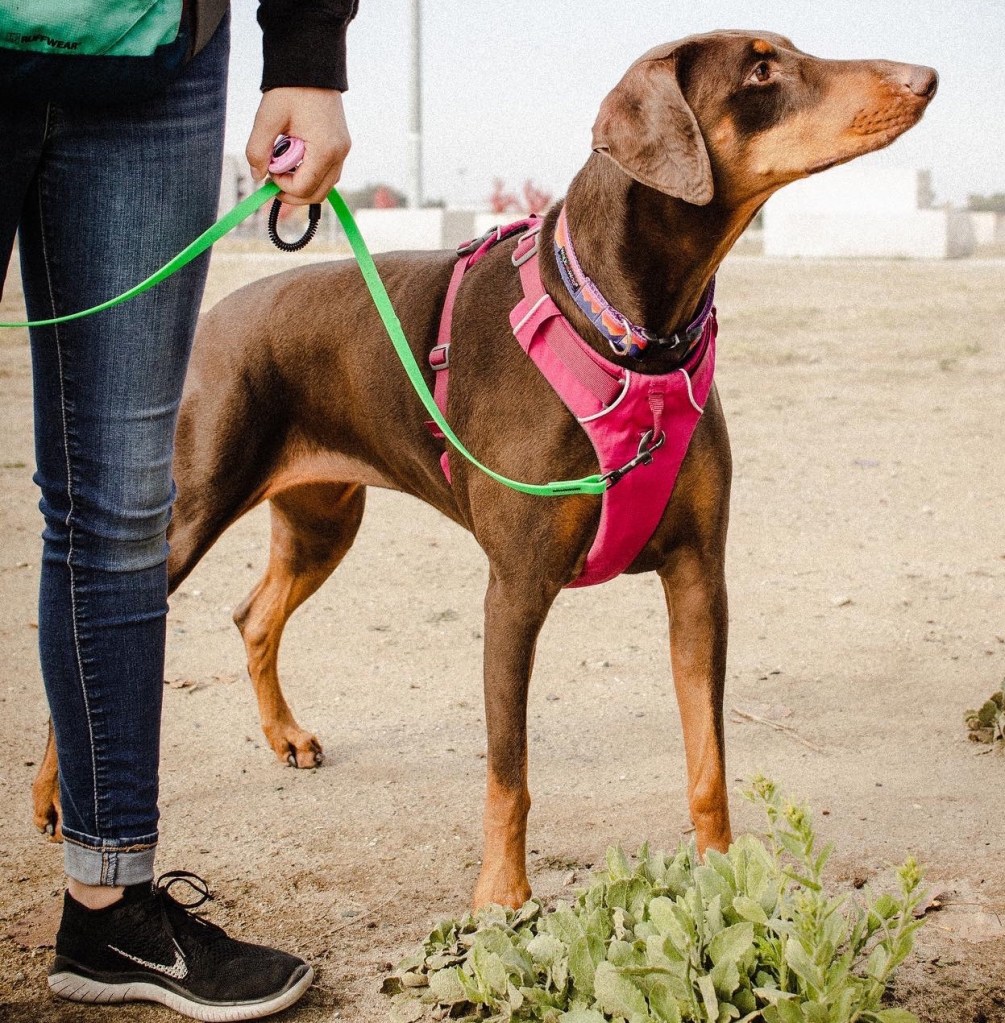
Q: How do I get my dog to follow commands?
A: First, you need to be able to reliably get your dog to perform the desired behavior. Once you have them consistently repeating the behavior, you can begin attaching a cue by saying it each time the dog repeats the behavior. Eventually you will click and reward only if the behavior is performed after the cue is given.
Q: What if my dog doesn’t do what I ask?
A: First, take a moment to think about why the dog might be confused.
- Consider the environment and how it might be different from where/when you trained.
- Make sure you’re rewarding them with something they’re willing to work for.
- Revisit earlier training exercises to make sure the dog understands the cue, and practice in different environments with high value rewards.
Q: Why use a clicker to train?
A: The sound of a clicker “marks” the desired behavior. You can also use a word like “Yes” or “Good”. Using a marker speeds up the learning process by clearly communicating what behavior is being rewarded.
Q: How do I get my dog to stop doing something using clicker training?
A: If a behavior is not reinforced, the frequency of that behavior will decrease which means the animal will naturally do it less and less. A certified dog trainer can help you identify how the unwanted behavior might be accidentally reinforced in your dog’s routine. They can also teach your dog a new behavior to perform in those situations instead.
Q: Why not use punishment?
A: Punishment is an important element of operant conditioning. Actions that result in punishment are less likely to occur again, which happens naturally throughout life. However, punishment doesn’t inspire new behaviors. It’s difficult to mark exactly what behavior is being punished, and punishment often occurs well after the behavior was performed. Punishment can cause animals to avoid training sessions rather than becoming excited to train. On top of all that, there are multiple academic studies published which suggest that the combination of punishment and positive reinforcement is less effective than using positive reinforcement alone.
Q: But how does my dog know when they’ve made a mistake?
A: If the dog didn’t get a click, they know they didn’t meet the criteria you were looking for. Some trainers use a No Reward Marker (NRM) like “uh uh” when criteria isn’t met. However, there is evidence that even an NRM can be aversive to dogs that are particularly sensitive. If your dog is repeatedly not meeting criteria, best practice would be to revisit your training plan and adjust to something you know your dog can achieve – before raising criteria again. ALWAYS set your learner up for success!
Q: Do I need to keep using a clicker and treats forever?
A: Nope! Once a dog has learned a behavior and reliably performs it when cued, a clicker is no longer needed for that behavior. Now that they know the rules of the game, you can simply reward them with verbal praise, a pat on the head, or a chance to do an activity that they like. Save the clicker and high value treats for training new behaviors!
Q: Can this training be applied to any animal?
A: Yes! Clicker training has been successfully used to train marine animals, reptiles, fish, livestock and even humans. The science applies to everyone!



 Saturn Dog Training